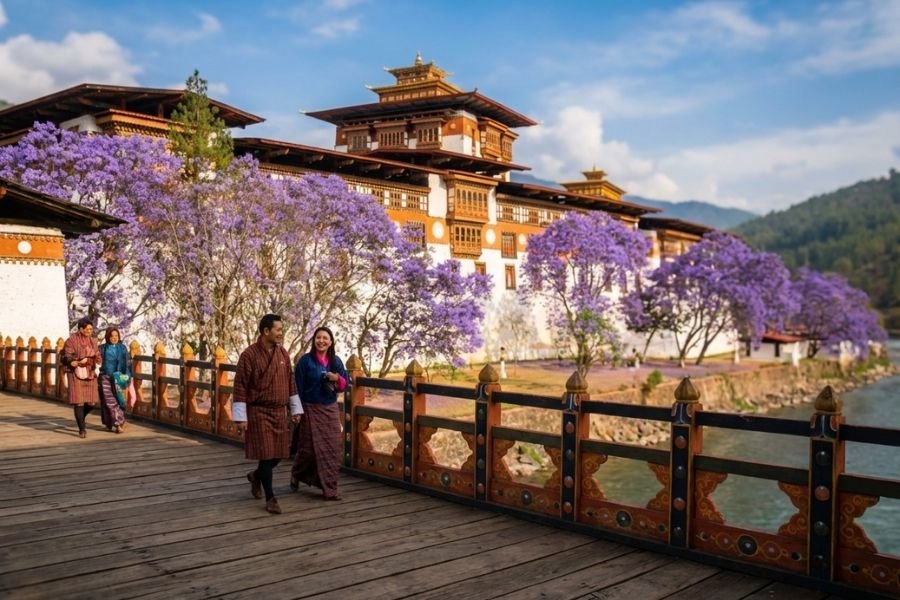
If Bhutan had a postcard-perfect valley, it would most probably be Punakha. Nestled among green mountains, terraced fields and rushing rivers, Punakha feels noticeably warmer and more tropical than the country’s high-altitude destinations.
Punakha Bhutan, remains one of the nation’s most significant cultural and historical sites. The magnificent dzong, traditional villages, suspension bridges, and peaceful countryside make it a must-see on any Bhutan itinerary.
And yes, there are mountains galore. But unlike some destinations where the mountains seem intent on making you work for the view, Punakha is fairly generous.
Where Is Punakha?
Located in western-central Bhutan, at an altitude of roughly 1,200 meters, Punakha. It is situated at the meeting point of the Pho Chhu and Mo Chhu rivers and forms the beautiful Punakha Valley.
The town is about 72 km from Thimphu, but dont be fooled by the distance; Bhutan’s mountain roads are full of curves, not straight lines.
| Information | Details |
|---|---|
| Location | Western-central Bhutan |
| Altitude | Around 1,200 m |
| Distance from Thimphu | Approximately 72 km |
| Former capital | Yes, until 1955 |
| Main rivers | Pho Chhu and Mo Chhu |
| Famous for | Punakha Dzong, Punakha Suspension Bridge, rice fields |
| Best for | Culture, nature, photography, hiking and relaxation |
Why Go To Punakha?
Punakha is a contrast to the hustle and bustle of Thimphu and the dramatic cliffs of Paro.
It is warmer and greener in the valley and surrounded by agricultural landscapes. Rice fields cover the countryside, and traditional Bhutanese houses are nestled in the forested mountains.
Punakha Dzong is obviously the main attraction, but the destination is more than one magnificent building.
Hike to Khamsum Yulley Namgyal Chorten, cross one of Bhutan’s famous suspension bridges Chimi Lhakhang River activities, or just spend an afternoon exploring the valley.
Simply put, Punakha is the place you go when your itinerary requires a little less hustle and a little more “let’s just enjoy this view.”
Top Places to Visit in Punakha
1. Punakha Dzong
Punakha Dzong, officially known as Pungtang Dechen Phodrang Dzong, is the star attraction of Punakha.
The 17th-century fortress-monastery built by Zhabdrung Ngawang Namgyal is dramatically located at the confluence of the Pho Chhu and Mo Chhu rivers.
Its architecture is impressive from almost every angle, but the approach across the traditional cantilever bridge makes for an even more memorable view.
Inside, visitors can see ornate woodwork, murals, Buddhist artwork and important religious spaces.
The dzong is also of great historical significance. When Punakha was the capital of Bhutan, it was the administrative centre of the country.
Travel tip: Visit in spring, and the jacaranda trees around the dzong render an already photogenic place almost unfairly beautiful.
2. Suspension Bridge
The famous suspension bridge over the Pho Chhu River, near Punakha Dzong.
The bridge is decorated with colourful prayer flags and spans the river with excellent views of the surrounding valley.
It’s also a great place to find out if you are really comfortable with heights, or just hopeful about them.
The bridge is a popular spot for both visitors and locals, so take your time crossing and enjoy the scenery rather than making it a race.
3. Khamsum Yulley Namgyal Chorten
If you enjoy short hikes, Khamsum Yulley Namgyal Chorten should be at the top of the list for travellers.
After crossing a suspension bridge, the trail continues through rice fields and countryside before climbing toward the chorten.
It’s usually a 45-minute to one-hour hike one way, depending on your pace.
The reward is a four-storey Buddhist building beautifully decorated with panoramic views across the Punakha Valley. This is one of the country’s notable hiking experiences, according to the official Bhutan tourism site.
Wear comfortable shoes. Your Instagram account may be ready for the hike. Your knees should be too.
4. Chimi Lhakhang
One of Bhutan’s most distinctive temples is Chimi Lhakhang, an unusual temple in the countryside near Punakha.
It is associated with the Divine Madman, Drukpa Kunley, a popular but unorthodox Buddhist saint who used humour and outrageous methods to teach Buddhism.
The temple is traditionally associated with blessings of fertility, and the surrounding village is known for its unique artwork and cultural traditions.
The walk to the temple is through fields and countryside, and the walk itself is a vital part of the experience.
5. The Valley of Punakha
Sometimes the destination itself is the best attraction.
Drive through the valley for a while, walk by the rice fields or stop at the small villages.
The scenery can change dramatically with the seasons. Green farm fields, flowering trees, mountain slopes and river valleys create an ever-changing backdrop.
If your Bhutan itinerary has been a whirlwind of dzongs and monasteries, Punakha is also a good place to relax a bit.
What to Do in Punakha
Punakha is more than just sightseeing, there are plenty of things to do in Punakha. The valley offers a range of experiences for travellers who want to do more than just take photos.
Trekking
The Khamsum Yulley Namgyal Chorten hike is an easy way to combine culture, exercise and scenery.
There are other hiking routes in the wider Punakha region, so those interested in longer walks should speak to a local guide about suitable trails.
Things to Do on the River
Depending on season and local operating conditions, there is an opportunity for rafting on the Pho Chhu and Mo Chhu rivers.
The Mo Chhu is generally milder for rafting, while the Pho Chhu has more difficult rapids.
Always operate with a licensed operator and follow local safety instructions.
Explore Bhutanese Food
Punakha is a great place to try traditional Bhutanese food.
Expect lots of chili and cheese, especially in dishes like ema datshi. Bhutanese food just doesn’t care about the concept of “just a little chilli”.
Other dishes to try are phaksha paa, jasha maru, red rice and Bhutanese dumplings.
If you don’t do well with spice, make that known. The medium spicy and Bhutanese spicy are two very different definitions.
Discover Rural Bhutan
One of the biggest attractions of Punakha is the countryside.
Experience traditional villages, see agricultural life and relax in the valley’s slower pace. Especially rewarding for travellers interested in photography and cultural experiences.
When to visit Punakha
The best time to visit Punakha depends on what you’re after from the trip.
Spring (March to May) brings along pleasant temperatures, blooming flowers and greenery. This time can be especially lovely in the vicinity of Punakha Dzong.
In autumn (September to November) you can usually expect clear mountain views and good conditions for sightseeing and hiking.
Winter (December to February) can be quiet and relatively pleasant in Punakha as the valley is lower and warmer than many other areas of Bhutan.
Monsoon (June to August): Rain, which can impact mountain roads and outdoor activities. But the valley is green and lush.
Season | What to expect |
March–May | Pleasant weather, flowers, green landscapes |
June–August | Rainy, lush countryside |
September–November | Clearer skies, excellent sightseeing |
December–February | Cooler, quieter and relatively mild |
Arrival at Punakha From Thimphu
The most common way to go to Punakha is by road from Thimphu.
The route generally traverses Dochula Pass, at about 3,100 meters. The pass is famous for its 108 Druk Wangyal Chortens and spectacular views of the Himalayas on clear days.
The trip takes about 2.5 to 3.5 hours, although mountain roads and weather can affect the time taken.
From Paro to Punakha
The majority of visitors coming through Paro International Airport will go to Thimphu before continuing on to Punakha.
The journey between Paro and Punakha can take several hours, and it is usually more comfortable to break the journey than to try and see everything in one heroic day.
Where to stay in Punakha?
If you are looking for a hotel at Punakha, you will find options ranging from comfortable hotels and resorts to traditional-style stays and more rural properties. You get to stay in the valley and experience the quieter atmosphere (rather than just visiting for a few hours). Choose lodging surrounded by greenery or with a view of the valley for the best experience. If you are travelling at peak times, it is advisable to book in advance.
How many days in Punakha is enough?
Most travellers find 2 days and 1 night to be the ideal amount of time.
Punakha 2 Day Itinerary
Day 1
- Drive from Thimphu to Punakha.
- Dochula Pass Stop.
- See Punakha Dzong.
- Walk across the suspension bridge to visit the valley.
- Overnight stay in Punakha.
Day 2
- Go to Chimi Lhakhang.
- Trek to Khamsum Yulley Namgyal Chorten.
- Lunch with a view over the valley.
- Try a local activity or visit nearby villages.
- Proceed to your next destination in Bhutan.
If you have three days, you can take the itinerary slower, spending more time hiking, enjoying the countryside, and experiencing local culture.
Punakha Travel Advice
Wear comfortable walking shoes, especially if you plan on hiking.
Bring a light jacket as the weather on the mountain can change rapidly.
When visiting monasteries and dzongs, dress modestly. Some religious areas may have limited photography. Carry water on hikes. Roads may be winding; allow extra travel time. Be respectful of local customs and religious observances. Don’t rush through Punakha to check off attractions.
SDF and Bhutan Travel Permit for Indian Travellers
Visitors from India need a permit to enter Bhutan. Official tourism information from Bhutan states that Indians can apply before travel or at the point of entry, but it is best to apply before travel to avoid any waiting time.
The Sustainable Development Fee (SDF) currently is INR/Nu. 1,200 per person per night for Indian nationals, with a concession for children between 6 and below 12 years of age.
Bhutan’s travel regulations and fees may change, so check the official Bhutan tourism website before finalizing your trip.
Final Thoughts on Punakha
Punakha is the type of place that doesn’t need to shout for attention.
It is the mix of history, architecture, rivers, mountains, farmland, and everyday Bhutanese life that makes it attractive.
The valley offers a more relaxed experience of Bhutan, from the grandeur of Punakha Dzong to the peaceful paths that meander through rice paddies.
So if Thimphu gives you the city, Paro gives you the iconic mountain scenery, and Punakha gives you something a little different: room to breathe, beautiful landscapes, and a glimpse of Bhutan at its most peaceful.
And honestly, some quiet is probably just what the doctor ordered after those mountain roads.
What is Punakha famous for?
Punakha is famous for Punakha Dzong, its riverside scenery, suspension bridge and traditional Bhutanese countryside. The valley also holds historical significance as Bhutan’s former capital.
Which are the best places to visit in Punakha?
The main attractions include Punakha Dzong, Punakha Suspension Bridge, Khamsum Yulley Namgyal Chorten, Chimi Lhakhang and the surrounding Punakha Valley. Together, they offer a mix of architecture, spirituality, hiking and rural scenery.
How many days are enough to explore Punakha?
Two days and one night allow travellers to explore the main attractions, including Punakha Dzong, the suspension bridge, Chimi Lhakhang and Khamsum Yulley Namgyal Chorten. Three days offer more time for village visits and a slower sightseeing pace.
What is the best time to visit Punakha?
March to May and September to November are generally favourable for sightseeing and hiking. Spring brings flowers and greenery, while autumn offers opportunities for clearer views. Winter is another option for travellers who prefer cooler weather.
How can I reach Punakha from Thimphu?
Punakha is commonly reached by road from Thimphu via Dochula Pass. The drive generally takes around 2.5 to 3.5 hours, depending on weather, traffic and sightseeing stops.
How difficult is the Khamsum Yulley Namgyal Chorten hike?
The hike usually takes around 45 minutes to one hour each way, depending on your pace. The route passes through countryside and rice fields before climbing uphill to the chorten. Comfortable walking shoes and drinking water are recommended.