The road just…ends.
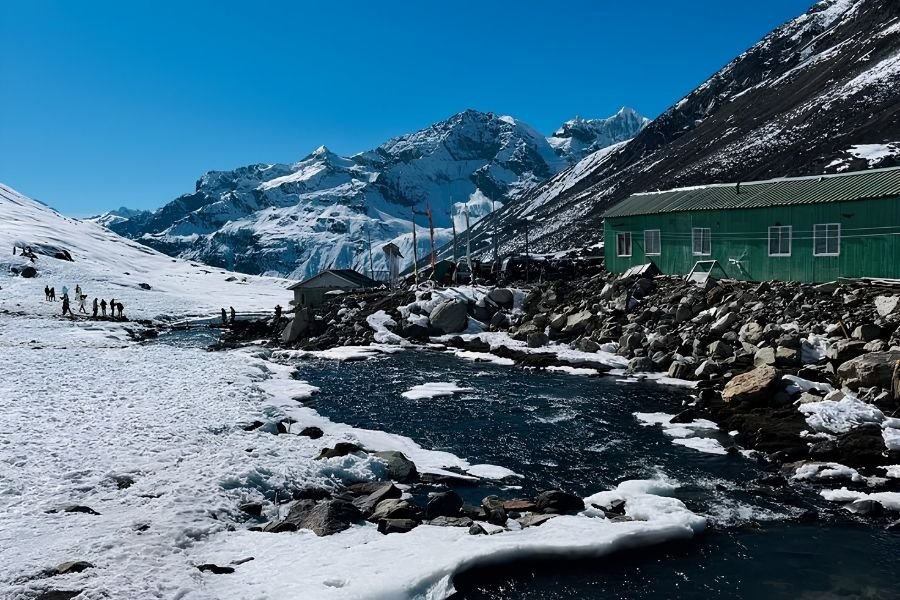
No more tarmac, no more villages, no more “next town 20 km” signs. Just snow as far as the eye can see, prayer flags flapping in the wind, and air so thin you get breathless walking up a slight slope.
Here is Zero Point Sikkim, at 15300 ft. This is as far as a civilian vehicle can go in North Sikkim. Only the Army goes beyond that.
It takes an early alarm, a permit and a strong stomach for the hairpin bends to get you here. Here’s what you need to do it right.
Planning a visit? Explore our North Sikkim tour packages for help planning your route, local transport and stay.
North Sikkim, Zero Point Sikkim covered in snow with prayer flags and Himalayan peaks.
Zero Point Sikkim in One Breath
| Detail | Quick Answer |
|---|---|
| Also called | Yumsamdong |
| Altitude | About 15,300 ft (around 4,660m) |
| District | Mangan (North Sikkim), near the India China border |
| Base village | Lachung |
| Distance from Lachung | Roughly 45 to 50 km (2 to 3 hrs one way) |
| Distance from Gangtok | Around 150+ km (overnight stop at Lachung needed) |
| Best time | March to June |
| Permit | Protected Area Permit, via a registered tour operator |
| Who can go | Indian nationals only |
| Entry fee | None, but the extra vehicle run is usually charged separately |
Seems simple on paper. But the name itself confuses many travellers.
Ready to explore Zero Point? Check our North Sikkim tour packages to plan the Lachung and Yumthang Valley circuit.
So What Is Zero Point Sikkim, Exactly?
Zero Point means the end of the road for civilians. The official name of the area is Yumesamdong and that’s why you will find Yumesamdong Zero Point on maps and in permit papers.
And no, there is no Zero Point at Gangtok. That’s how a lot of people look for it, because almost every trip to it begins in Gangtok. Beyond Lachung and the Yumthang Valley, where the Lachung Chu river rises in the snow, is Real Zero Point North Sikkim, much higher up.
You’ll know you’re there when the road ends and everyone’s throwing snowballs. Now how much is that, compared to where you begin?
The Climb: From Gangtok to the Edge
The trip to Zero Point Sikkim is actually a climb of 7,000 ft, done over two days. This is how the height changes on the road.
| Stop | Approx. Altitude | What’s Happening |
|---|---|---|
| Gangtok | 5,400 ft | Pick up permits, start the drive north |
| Seven Sisters Waterfall | Roadside | First photo stop out of Gangtok |
| Mangan / Chungthang | 4,000–5,000 ft | Checkposts, lunch break |
| Lachung | 8,600 ft | Overnight halt, a quiet apple orchard village |
| Yumthang Valley | 11,700 ft | Meadows, rhododendrons, hot springs |
| Zero Point (Yumesamdong) | 15,300 ft | Snow, wind, and the end of the road |
Gangtok to zero point in one day? Nope, and it’s not safe. Anyone who promises a trip to Zero Point from Gangtok in the same day is ignoring the acclimatisation your body needs. The drive to Lachung alone takes 6-7 hours. The normal route is Gangtok to Lachung on day one and then Lachung to Yumthang Valley to Zero Point on day two.
Hence most of the travellers opt for the Gangtok to Yumthang Valley Zero Point circuit as a 2-night 3-day North Sikkim trip.
Make the route easy to plan: See our North Sikkim tour packages and choose an itinerary that includes Lachung and Yumthang Valley.
So what does the big second day actually look like?
Zero Point Sikkim Day: How the Morning Unfolds
This is a day you will remember. Most travellers call it the Lachung-Zero Point run as it starts from Lachung. And it starts painfully early too.
| Time | What You’ll Be Doing |
|---|---|
| 5:00 am | Wake up in Lachung. Tea, layers, out the door |
| 5:30 am | Leave Lachung, heading north towards Zero Point Sikkim |
| 6:30 am | Quick stop to rent gumboots and heavy jackets if needed |
| 8:00 am | Reach Zero Point Sikkim. Snow, photos, hot Maggi at a tea stall |
| 9:00 am | Start back down before clouds and wind roll in |
| 10:00 am | Yumthang Valley: meadows, river, hot springs |
| 1:00 pm | Back in Lachung for lunch, or continue towards Gangtok |
So early?” Mornings usually clear. By late morning the peaks are usually lost in clouds and the wind is fierce. Come late and Zero Point Sikkim may show you nothing but white fog.
The other big question, though: when should you come at all?
Snow Calendar: Best Time to Visit Zero Point Sikkim
| Months | Snow at Zero Points | Road Access | Verdict |
|---|---|---|---|
| March to April | Deep snow everywhere | Usually open | Best for snow lovers |
| May to June | Snow on the slopes, rhododendrons at Yumthang | Open | Best all rounder |
| July to September | Patchy | Landslide prone | Risky, poor views |
| October to November | Light early snow, very clear skies | Mostly open | Great views, very cold |
| December to February | Heavy snow | Often closed | Usually not accessible |
Classic choice is zero point Sikkim in April. You get thick snow for the full winter wonderland experience, along with milder temperatures than mid-winter. April is peak season and permits and hotels fill up so book early.
May is coming up fast. At the top you get snow and the rhododendrons in bloom at Yumthang on the way down. Two seasons, one trip.
No matter what month you choose, the paperwork comes first.
Permits & Rules: The Boring-But-Vital Bit
Zero Point North Sikkim is a protected border area and you cannot drive yourself up to Zero Point Sikkim.
| Rule | What It Means for You |
|---|---|
| Permit | Protected Area Permit for North Sikkim |
| How to get it | Through a registered tour operator in Gangtok, which is usually part of your package |
| Documents | Photo ID (Aadhar, voter ID or driving licence) plus passport-size photos |
| Vehicle | Only locally registered, permitted vehicles. No self-drive beyond the checkposts |
| Foreign nationals | Can usually visit Yumthang Valley, but not Zero Point |
| Extra cost | The run from Yumthang to Zero Point is usually charged extra per vehicle. Confirm when booking |
Landslides or heavy snow can change the rules and road status, so always check with your operator a few days before you travel.
Sorted permit? Then let’s talk about what’s up there.
What You'll See at Zero Point Sikkim (15,300 ft)
- Endless snow fields. In the spring there can be several feet of snow on each side of the road.
- Himalayan peaks bare. Towering ridges shut in on three sides.
- Streams covered in ice. From these snowfields the Lachung Chu begins its journey.
- Prayer flags and yaks. Colour shots against all that whiteness.
- Tea-rooms. A few makeshift shacks selling hot tea, coffee and instant noodles. Nothing tastes better at -5°C.
No village, no ATM and no proper washroom. It’s barren, raw and spectacular. And your body will feel the height.
Plan a safer, well-organised North Sikkim trip: Explore North Sikkim tour packages and allow time for the high-altitude journey.
Plan Your Zero Point Trip with Sikkim Darjeeling Tourism
Permits, local transport, 5 am start for Zero Point Sikkim, a comfortable stay in Lachung, the extra Zero Point run. There’s a lot to coordinate from home.
Sikkim Darjeeling Tourism takes care of everything with tailor made North Sikkim packages from Gangtok, Siliguri or Kolkata. Local experienced drivers, permit assistance and cold weather stays selected.
Start planning your trip: Explore North Sikkim tour packages, Sikkim tour packages or Gangtok tour packages and enquire about a customised itinerary.
What is Zero Point Sikkim also called?
Zero Point Sikkim is also known as Yumesamdong. It is located beyond Yumthang Valley in North Sikkim, near the India–China border.
How high is Zero Point Sikkim?
Zero Point is approximately 15,300 feet (about 4,660 metres) above sea level.
How far is Zero Point from Lachung?
Zero Point is roughly 45–50 km from Lachung, and the drive usually takes around 2–3 hours one way, depending on road and weather conditions.
Can I visit Zero Point Sikkim from Gangtok in one day?
The article recommends against travelling from Gangtok to Zero Point and back in one day. The usual route includes an overnight stay in Lachung, followed by a visit to Yumthang Valley and Zero Point the next morning.
Do I need a permit to visit Zero Point Sikkim?
Yes. The article states that a Protected Area Permit is required and is generally arranged through a registered tour operator. Confirm current permit requirements and documents with the operator before departure.