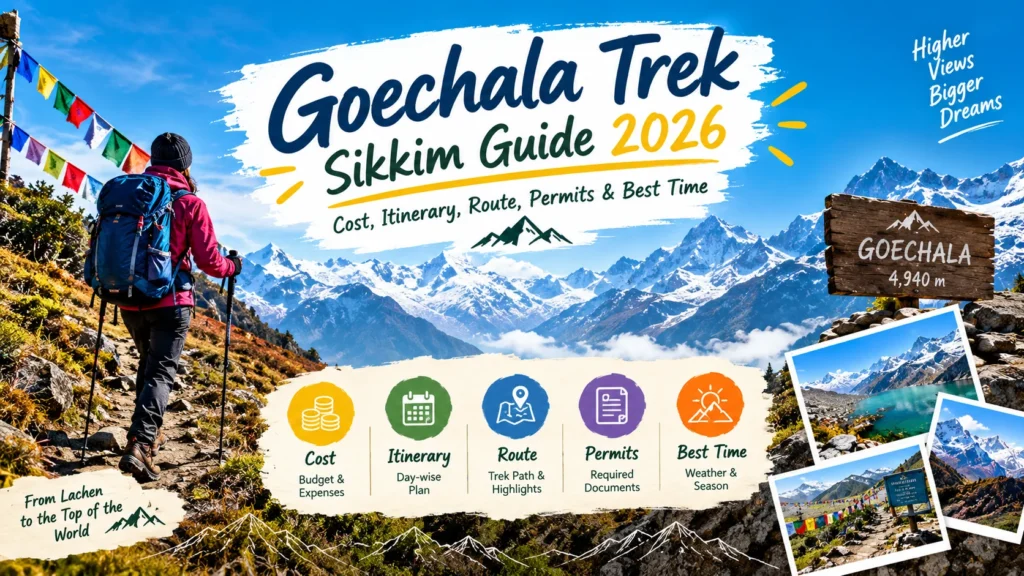
If you have ever dreamed of standing close to the mighty Kanchenjunga, the Goechala Trek in Sikkim is an adventure that deserves a place on your Himalayan bucket list. Deep in the Eastern Himalayas, the trail takes trekkers through dense mountain forests, rhododendron-covered landscapes, high-altitude meadows, dramatic mountain viewpoints and the serene surroundings of Samiti Lake. Starting from the historic village of Yuksom and passing through Dzongri, the journey gradually takes you deeper into the Himalayan wilderness.
But the Goechala Trek Sikkim experience is about more than reaching a high-altitude pass. It is about waking up before sunrise in the mountains, walking through forests scented with pine and earth, watching the landscape change with altitude and seeing the first golden light fall across the Kanchenjunga range. For trekkers, photographers and adventure seekers, this is one of the most rewarding ways to experience the high mountains of Sikkim.
In this Goechala Trek guide 2026, we cover the important things you need to know before planning your journey, including the route, itinerary, approximate cost, permits, difficulty level, best time to visit and essential preparation tips.
Planning a Sikkim Trip Around Your Goechala Trek?
Make your trekking adventure part of a complete Sikkim holiday. Explore our Sikkim tour packages and plan your journey around Goechala, Yuksom, Pelling, Gangtok and other destinations across Sikkim.
What Makes the Goechala Trek So Special?
The Goechala Trek is one of Sikkim’s most sought-after high-altitude trekking experiences because of the variety of landscapes packed into one journey. The trail begins around Yuksom and gradually moves through forests and mountain settlements before reaching the higher landscapes around Dzongri and Goechala. The trek is generally planned over several days, with the exact duration and route depending on the trekking itinerary, conditions and operator.
Here are some of the experiences that make the Goecha La Trek so memorable.
1. Incredible Views of Kanchenjunga
One of the biggest attractions of the Goechala Trek is the opportunity to experience spectacular views of the Kanchenjunga range. The higher viewpoints provide dramatic Himalayan scenery, particularly around sunrise when the snow-covered peaks begin changing colour in the early morning light. For many trekkers, reaching the viewpoint and seeing the mountains illuminated by the first rays of sunlight becomes one of the defining moments of the trek.
2. The Famous Dzongri Sunrise
Dzongri is one of the major highlights along the Goechala route. An early-morning climb to a viewpoint around Dzongri can reward trekkers with expansive views of the surrounding Himalayan peaks. As the sun rises, the mountains gradually take on shades of gold, orange and pink. The experience is particularly memorable because it comes after trekking through the quiet mountain landscape in the early hours of the morning.
3. Pine, Magnolia and Rhododendron Forests
The lower and middle sections of the Goechala Trek route pass through beautiful forest landscapes. Depending on the season, trekkers may encounter pine, magnolia and rhododendron vegetation along the trail. During the flowering season, rhododendrons can add striking colour to the landscape. The forest sections also provide a welcome contrast to the open high-altitude terrain encountered later in the trek.
4. The Serenity of Samiti Lake
Samiti Lake is one of the most visually striking points on the Goechala trail. Surrounded by high mountains, the lake creates an incredibly peaceful setting, particularly in the early morning. When the weather is clear, the surrounding peaks can be reflected on the surface of the lake, creating a scene that feels almost unreal. For photographers, Samiti Lake is one of the locations worth taking time to appreciate rather than simply passing through.
5. The Changing Himalayan Landscape
Another reason to choose the Goechala Trek is the variety of terrain. The journey gradually changes from forested trails around Yuksom to higher mountain landscapes around Dzongri and the Goechala region. This constant change keeps the trek visually interesting and allows you to experience several different Himalayan environments during one journey.
Explore Sikkim & Darjeeling Packages
Where Does the Goechala Trek Start?
The traditional starting point of the Goechala Trek is Yuksom in West Sikkim. Often described as the gateway to the Goechala trail, Yuksom is surrounded by forests and mountains and has long been associated with Sikkim’s history and trekking routes.
Trekkers commonly reach Yuksom from destinations such as Gangtok, Pelling, Siliguri or the Bagdogra side before beginning the trekking portion of their journey. If you are travelling through West Sikkim before the trek, Pelling can also be included in your broader Sikkim itinerary.
The source itinerary places Pelling approximately 40 km from Yuksom, with the journey taking around two hours depending on road and travel conditions. A stay in Pelling can also allow travellers to explore attractions such as Pemayangtse Monastery and the surrounding mountain scenery before continuing towards Yuksom.
Goechala Trek Route
The Goechala Trek route gradually takes you from the lower forested regions around Yuksom towards the high-altitude landscapes of Dzongri and Goechala.
A typical route broadly follows this progression:
Yuksom → Sachen → Tshoka → Dzongri → Thangsing → Samiti Lake → Goechala Viewpoint → return via the same general route
The exact camps, distances and number of trekking days can vary depending on the itinerary and current trail conditions.
Goechala Trek Cost
The Goechala Trek cost depends on the trekking operator, group size, inclusions, guide services, permits, accommodation, food, transportation and porter support.
The supplied source gives the following approximate figures:
- Guide and trek permits: ₹3,000–₹4,000 per day
- Porter/helper: ₹1,000–₹1,200 per day
- Food and stay during the trek: ₹600–₹900 per day
- Pelling–Yuksom transport: ₹2,000–₹3,000 per day
These figures should be treated as approximate source-provided figures rather than guaranteed 2026 prices.
Looking Beyond the Trek Cost?
If you are planning a complete Sikkim holiday along with your Goechala adventure, compare our Sikkim tour packages for different itineraries, destinations and travel durations.
Goechala Trek Permits
Permits are an important part of planning a trek in Sikkim. The supplied source mentions trek permits as part of the overall guide and permit cost, but it does not provide a detailed 2026 permit list, issuing authority or current fee structure.
Therefore, travellers should confirm the current permit requirements, applicable restrictions and fees with their authorised trekking operator or the relevant Sikkim authorities before departure. This is particularly important because access rules and high-altitude trekking regulations can change.
Goechala Trek Itinerary
The exact Goechala Trek itinerary varies according to the trekking operator, route conditions, acclimatisation requirements and the specific itinerary chosen. A longer itinerary is generally preferred for allowing sufficient time for acclimatisation and recovery.
A representative itinerary can look like this:
Day 1: Reach Yuksom
Arrive in Yuksom, check into your accommodation and use the day to rest and prepare. If you are coming from a lower-altitude destination, this is also a useful opportunity to adjust before starting the trek.
Day 2: Yuksom to Sachen
Begin the trek from Yuksom and enter the forested trail. The route introduces you to the natural surroundings of the Goechala region.
Day 3: Sachen to Tshoka
Continue through the forest towards Tshoka. The trail gradually gains altitude and the surroundings begin to feel more alpine.
Day 4: Tshoka to Dzongri
This is an important stage of the journey as you move towards Dzongri. The landscape becomes more open, and the mountain views begin to expand.
Day 5: Dzongri Acclimatisation and Sunrise
Spend time around Dzongri and experience the famous early-morning mountain views. An acclimatisation day can also help trekkers prepare for the higher sections of the trail.
Day 6: Dzongri to Thangsing
Continue towards Thangsing through increasingly high-altitude terrain. The landscape becomes more dramatic as you move closer to the Goechala region.
Day 7: Thangsing to Samiti Lake and Goechala Viewpoint
This is one of the most anticipated sections of the trek. Depending on the itinerary and trail conditions, trekkers make an early start towards the viewpoint area to experience the Himalayan sunrise and mountain views.
Day 8 onwards: Return Journey
After reaching the high point of the itinerary, the trail descends towards the lower camps and eventually returns to Yuksom. The number of return days depends on the chosen itinerary.
FAQs
How difficult is the Goechala Trek?
The Goechala Trek is a challenging high-altitude Himalayan trek. Trekkers should have good physical fitness, endurance and preparation for consecutive days of walking and altitude gain.
How long is the Goechala Trek?
The supplied source places the overall trek distance at approximately 78–90 km and describes an itinerary of around 11 days. The actual distance and duration can vary according to the route and trekking operator.
Where does the Goechala Trek start?
The trek traditionally starts from Yuksom in Sikkim, which serves as the gateway to the trail.
What is the best time for the Goechala Trek?
The source identifies March to May and September to November as the preferred periods. Monsoon conditions from June to August and heavy winter snow from December to February can make the trek more difficult or inaccessible.
How much does the Goechala Trek cost?
The cost varies according to the operator and inclusions. The supplied source provides approximate daily costs for guides, permits, porters, food, accommodation and transportation, but travellers should confirm current 2026 prices before booking.
Do I need a permit for the Goechala Trek?
The source confirms that permits form part of the trek planning and cost, but it does not provide a definitive 2026 permit list or fee structure. Current requirements should therefore be confirmed with an authorised trekking operator or the relevant authorities.
Is Goechala suitable for beginners?
The trek is physically demanding and reaches high altitude, so beginners should not approach it casually. Those without previous high-altitude trekking experience should prepare properly and trek with appropriate professional guidance.